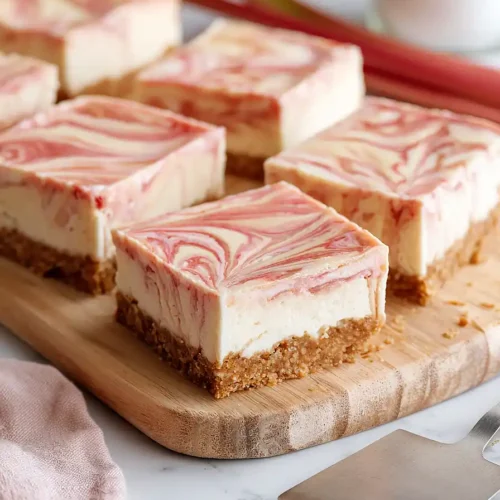
Perfect Rhubarb Cheesecake with Graham Cracker Crust
Delicious Perfect Rhubarb Cheesecake with Graham Cracker Crust recipe with step-by-step instructions.
Ingredients
For the rhubarb compote
- 14 oz rhubarb, cut into 1-inch lengths
- 0.9 cup sugar
- 1/2 tsp vanilla
- 1/2 tsp lemon juice
- 1 pinch salt
For the graham cracker base
- 4.7 oz graham cracker crumbs
- 1.5 tbsp sugar
- 1 pinch salt
- 3 oz butter, melted and cooled
For the cheesecake filling
- 6.5 oz cold heavy cream
- 1.25 tsp gelatine powder
- 8 oz cream cheese, room temperature
- 0.35 cup sugar
- 1/2 tsp vanilla
- 1/4 tsp salt
- 1/8 tsp ground ginger
- 7.4 oz rhubarb puree
Instructions
- Line a 9x13 inch baking dish with parchment paper for easy removal. Combine graham cracker crumbs, sugar, and salt in a bowl, then stir in the melted and cooled butter until the mixture resembles wet sand. Press this mixture firmly and evenly into the bottom of the prepared pan, using the bottom of a measuring cup to create a compact, even layer. Freeze the crust while you prepare the filling—this helps it stay intact when the filling is added.
- In a pot, combine the cut rhubarb, sugar, vanilla, lemon juice, and salt. Cook over medium heat, stirring occasionally, until the rhubarb completely breaks down and the mixture becomes thick and jam-like, about 15-20 minutes. The rhubarb will release its juices and gradually reduce into a concentrated puree. Blend the cooked mixture until completely smooth using an immersion blender or regular blender, then set aside to cool to room temperature. I like to strain the puree through a fine-mesh sieve if I want a silkier texture without any fibrous bits.
- Pour 55g (about 1/4 cup) of the cold heavy cream into a small pot and sprinkle the gelatin powder evenly over it. Let it sit for 1-2 minutes to bloom, then heat gently over low heat, stirring constantly until the gelatin is completely dissolved and the mixture is smooth. Do not boil or overheat, as this can damage the gelatin's setting properties. Once dissolved, remove from heat and let cool slightly—you want it warm enough to incorporate smoothly but not so hot that it cooks the cream cheese.
- In one bowl, whip the remaining heavy cream (about 130g) until stiff peaks form—this adds airiness and lightness to the final filling. In a separate bowl, beat the room-temperature cream cheese with sugar, vanilla, salt, and ground ginger until smooth and fluffy, about 2-3 minutes. The ginger adds a subtle warmth that complements rhubarb beautifully. I find that bringing cream cheese to room temperature prevents lumps and ensures a silky-smooth filling.
- Stir the cooled gelatin mixture from Step 3 into the cream cheese mixture from Step 4 until fully incorporated and smooth. Gently fold in the whipped cream from Step 4 using a spatula, being careful not to deflate the whipped cream—use a folding motion rather than stirring. Finally, fold in 150g of the cooled rhubarb puree from Step 2, folding just until streaks of rhubarb remain visible throughout the filling for a beautiful marbled effect.
- Remove the frozen crust from the freezer and pour the filling from Step 5 evenly over it, smoothing the top with a spatula. Dollop the remaining 50g of rhubarb puree in stripes or swirls across the surface, then use a knife or skewer to gently swirl it into the filling for a decorative marbled pattern. Refrigerate for at least 3 hours, or until the cheesecake is set and firm to the touch—you can also cover and refrigerate overnight for the best flavor development.
- Remove the cheesecake from the refrigerator and carefully lift it from the pan using the parchment paper. Place on a cutting board and slice into 12-16 bars or squares with a sharp, wet knife, wiping the blade between cuts for clean edges. Serve chilled, and enjoy the delightful contrast between the crumbly crust, creamy filling, and bright rhubarb flavor.