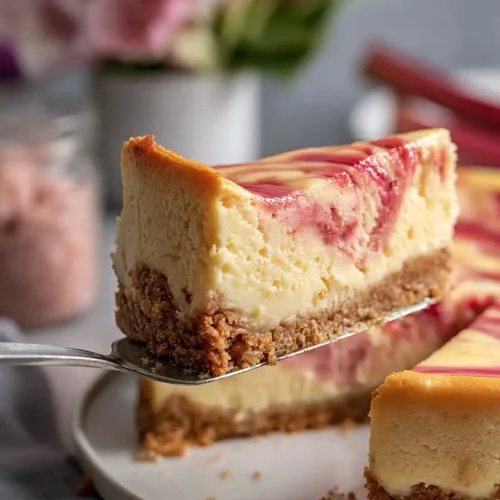
Irresistible Rhubarb and Custard Cheesecake
Delicious Irresistible Rhubarb and Custard Cheesecake recipe with step-by-step instructions.
Ingredients
For the rhubarb topping
- 9 oz rhubarb (cut into 1-inch lengths)
- 1/2 cup sugar
- 1 1/2 tsp cornstarch
- 2 tsp lemon juice
For the biscuit base
- 5.6 oz biscuits (crushed into fine crumbs)
- 1 tbsp brown sugar
- 3.5 oz butter (I like Kerrygold unsalted butter for this)
- 1 pinch salt
For the cheesecake filling
- 25.4 oz cream cheese (I prefer Philadelphia brand for best texture)
- 1/2 cup brown sugar
- 1/2 cup sugar
- 3 tbsp custard powder (I use Bird's for that classic yellow color)
- 1 tbsp vanilla essence
- 2 eggs (room temperature, about 70°F)
- 2 egg yolks
Instructions
- Cut the rhubarb into 1-inch lengths and place in a pot with 1/2 cup sugar and 2 tsp lemon juice. Bring to a boil, then reduce heat and simmer for 15 minutes until the rhubarb is very soft and breaks apart easily. Remove from heat and let cool slightly. Once cooled, blend the cooked rhubarb until smooth using a blender or immersion blender. In a small bowl, mix the cornstarch with 2 tablespoons of water to create a slurry, then stir this into the blended rhubarb. Return the rhubarb mixture to the pot over medium heat and cook for 2 minutes, stirring constantly, until it thickens slightly and coats the back of a spoon. Set aside to cool completely—I like to prepare this step first so the compote has time to cool while I work on other components.
- Preheat your oven to 180°C (350°F) and line an 8-9 inch springform tin with parchment paper. Crush the biscuits into fine crumbs—you can do this in a food processor or by placing them in a sealed bag and crushing with a rolling pin. Melt the butter over low heat or in the microwave in 30-second intervals, then combine it with the crushed biscuits, 1 tbsp brown sugar, and a pinch of salt, mixing until the texture resembles wet sand. Press this mixture firmly and evenly into the bottom of the prepared tin, using the bottom of a measuring cup to create an even layer. Bake for 10 minutes until lightly golden, then remove from the oven and set aside to cool slightly while you prepare the filling.
- Ensure your cream cheese and eggs are at room temperature (about 70°F) for a smooth, lump-free filling. In a large bowl, beat the cream cheese with 1/2 cup brown sugar and 1/2 cup white sugar until light and fluffy, about 2-3 minutes—this aerates the filling and creates a better texture. In a small bowl, whisk together the custard powder with 3 tablespoons of the cream cheese mixture to create a smooth paste with no lumps, then stir this paste back into the main bowl until fully combined. Add the vanilla essence and mix well. Add the whole eggs one at a time, beating on low speed after each addition just until combined—overmixing at this stage can incorporate too much air and cause cracks. Gently fold in the 2 egg yolks until fully incorporated. I prefer to use Philadelphia cream cheese here because it creates a denser, creamier texture that pairs beautifully with the rhubarb.
- Pour the custard cheesecake filling from Step 3 over the cooled biscuit base from Step 2, smoothing the top with a spatula. Spoon half of the cooled rhubarb compote from Step 1 over the filling in a few dollops, then use a fork to swirl it gently into the filling, creating a marbled effect—don't overmix or you'll lose the beautiful pattern. Place the tin in the oven and bake at 180°C for 10 minutes until the edges just begin to set, then reduce the oven temperature to 110°C and bake for a further 40 minutes. The cheesecake is ready when the edges are set but the center still has a very slight jiggle when gently shaken—this residual heat will continue to cook it as it cools. Turn off the oven, crack the door open about 2 inches, and let the cheesecake cool slowly inside for 2 hours. This gradual cooling prevents the sudden temperature change that causes cracks.
- Remove the tin from the oven and let the cheesecake cool completely to room temperature for at least 1 hour, then refrigerate for at least 4 hours (or overnight for best results). Run a thin knife around the edges of the tin to loosen the cheesecake, then carefully release the springform and transfer to a serving plate. Top each slice with a generous spoonful of the remaining cooled rhubarb compote from Step 1 just before serving.