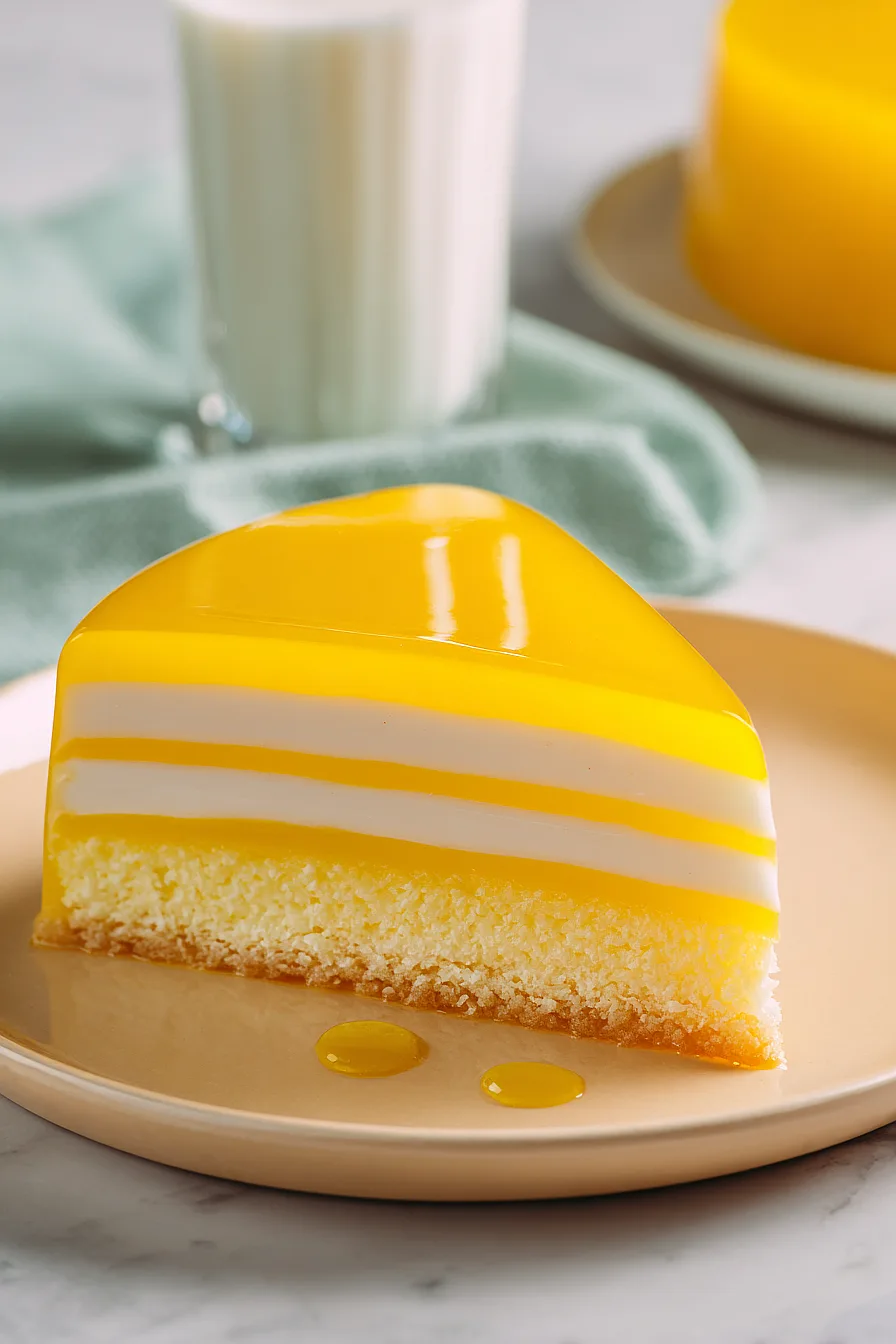
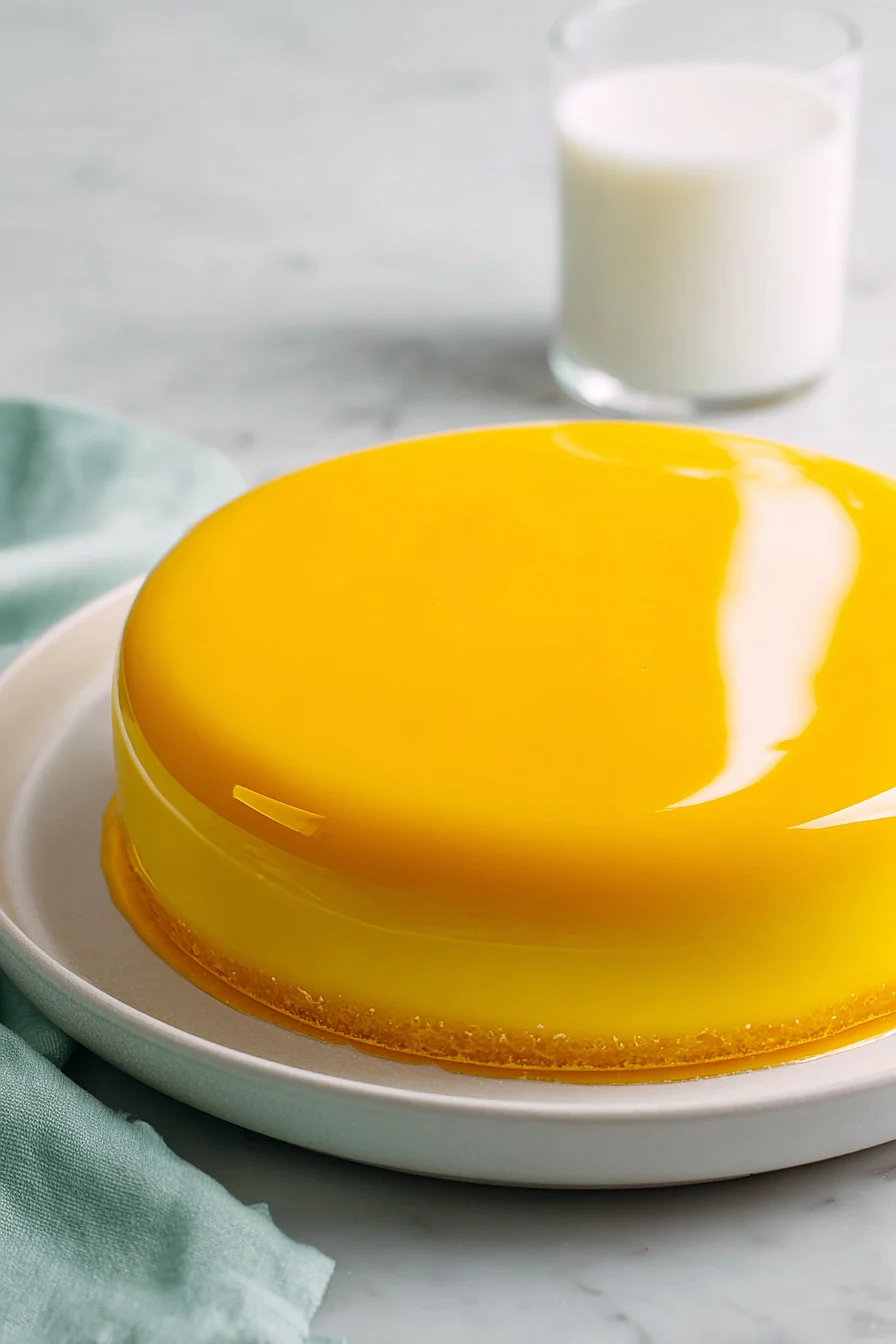
Here is my favorite coconut jelly cake recipe, with layers of smooth mango mousse, creamy coconut jelly, and a light sponge cake base, all topped with a sweet white chocolate glaze.
This coconut jelly cake is what I make when I want something a little different from regular cake. The tropical flavors remind me of summer, and my kids love how pretty the layers look when you slice into it. It takes a bit of time with all the gelatin layers, but it’s totally worth it!
Why You’ll Love This Coconut Jelly Cake
- Impressive layered dessert – This beautiful cake features multiple layers of mango and coconut that look like you spent hours at a fancy bakery, but you made it yourself at home.
- Light and refreshing – The combination of tropical mango and creamy coconut creates a dessert that’s not too heavy, making it perfect for warm weather or after a big meal.
- Make-ahead friendly – Since the layers need time to set in the fridge, you can prepare this cake a day before your gathering and have one less thing to worry about.
- Tropical flavor combination – If you love mango and coconut, this cake delivers those flavors in every bite with the fruity mango jelly balanced by smooth coconut cream.
What Kind of Coconut Milk Should I Use?
For this coconut jelly cake, you’ll want to use full-fat canned coconut milk rather than the carton kind you find in the refrigerated section. The canned version has a richer, creamier texture that will give your jelly layer the right consistency and flavor. Before using it, give the can a good shake since the cream and liquid tend to separate while sitting on the shelf. If you’re looking for a lighter option, you can use light coconut milk, but keep in mind that your cake will have a less creamy texture and milder coconut flavor.
Options for Substitutions
This recipe has some room for swaps, though a few ingredients are pretty important to keep:
- Gelatin sheets: If you only have powdered gelatin, you can substitute it – just use about 1 teaspoon of powder for every 2 gelatin sheets. Bloom it in cold water for 5 minutes before using.
- Mango puree and ground mango: Fresh mango works great if you blend it smooth. You can also try passion fruit or peach puree for a different flavor, though the taste will obviously change.
- Coconut milk: Full-fat coconut milk is best here for the right texture and flavor. Light coconut milk will work but might make the jelly less creamy. You could also try coconut cream for an even richer result.
- White chocolate: Make sure to use real white chocolate (with cocoa butter), not white coating chocolate. The real stuff melts better and tastes smoother in this recipe.
- Corn syrup: You can swap this with honey or golden syrup in the same amount. It helps keep the jelly smooth and prevents sugar crystals from forming.
- Sponge cake sheet: Store-bought sponge cake works fine if you don’t want to make your own. You could also use ladyfinger cookies arranged in a layer as a base.
Watch Out for These Mistakes While Baking
The biggest mistake when making layered jelly cakes is pouring the next layer before the previous one has set properly – each layer needs at least 30 minutes in the fridge to firm up, or you’ll end up with colors bleeding into each other and a messy final result.
When working with gelatin sheets, make sure to squeeze out all the excess water after soaking, as too much liquid can prevent your layers from setting firmly and create a wobbly texture.
Temperature is critical for the white chocolate glaze – if it’s too hot (above 95°F), it will melt your coconut layer, so let it cool to the recommended 30-32°F and test it on a spoon first to make sure it coats smoothly.
Finally, don’t skip the sifting step for the glaze, as this removes any lumps and gives you that smooth, professional-looking finish on top.

What to Serve With Coconut Jelly Cake?
This tropical cake is pretty rich on its own, so I like to keep things simple and serve it with a cup of hot tea or coffee to balance out the sweetness. A dollop of lightly sweetened whipped cream on the side adds a nice airy contrast to the dense jelly layers, and fresh mango slices or berries make it feel extra special without overwhelming the coconut and mango flavors. If you’re serving this for a party, consider pairing it with some vanilla ice cream or coconut sorbet, which melts into the cake and creates an amazing creamy texture. A sprinkle of toasted coconut flakes on top right before serving adds a nice crunch too.
Storage Instructions
Refrigerate: This coconut jelly cake needs to stay chilled to keep all those layers set properly. Cover it loosely with plastic wrap or keep it in a cake container in the fridge for up to 3 days. The gelatin layers hold up really well when kept cold.
Serve: Take the cake out of the fridge about 10-15 minutes before serving so it’s not too cold. This helps bring out the flavors and makes the texture a bit creamier. Slice it with a warm, wet knife for the cleanest cuts through all those pretty layers.
Not Freezer-Friendly: I wouldn’t recommend freezing this one. The gelatin layers and cream can separate and get watery when thawed, which kind of ruins that smooth, silky texture you worked so hard to create.
| Preparation Time | 60-90 minutes |
| Cooking Time | 90-120 minutes |
| Total Time | 150-210 minutes |
| Level of Difficulty | Hard |
| Servings | 8 slices |
Estimated Nutrition
Estimated nutrition for the whole recipe (without optional ingredients):
- Calories: 2800-3200
- Protein: 25-35 g
- Fat: 120-140 g
- Carbohydrates: 400-450 g
Ingredients
For the mango mousse:
- 12.5 oz ground mango
- 1/3 cup sugar
- 1/2 tbsp lemon juice
- 1.25 tsp gelatin sheet (soaked in cold water until soft)
- 1.1 cups mango puree
- 0.4 cup cream (I prefer Horizon Organic heavy cream for a richer mousse)
- 1/4 tsp vanilla extract
For the coconut layer:
- 1 cup coconut milk (I use Thai Kitchen for its high fat content and creaminess)
- 1.5 tbsp sugar
- 1.25 tsp gelatin sheet
- 1/4 tsp vanilla extract
For the white chocolate glaze:
- 1/3 cup mango puree (strained through a fine-mesh sieve for a smooth finish)
- 3 tbsp sugar
- 1/3 cup corn syrup
- 1 tsp gelatin sheet
- 2 fl oz cream
- 2.8 oz white chocolate (I like Ghirardelli baking bars for easy melting)
For the base:
- 1 sponge cake sheet (trimmed to fit a 6-inch cake ring)
Step 1: Prepare the Mango Base Layer
- 12.5 oz ground mango
- 1/3 cup sugar
- 1/2 tbsp lemon juice
- 1.25 tsp gelatin sheet
Combine the ground mango and 1/3 cup sugar in a pot and bring to a boil over medium heat, stirring occasionally.
Once boiling, remove from heat and stir in the lemon juice.
Let this cool to room temperature—this concentrates the mango flavor and creates a smooth base.
While the mango cools, soak 1.25 tsp gelatin sheet in cold water for about 10 minutes until softened.
Once softened, microwave the gelatin for 10 seconds until liquefied, then stir it into the cooled mango mixture.
I find that adding the gelatin while the mango is still slightly warm (not hot) helps it incorporate smoothly without clumping.
Step 2: Assemble the First Mango-Cream Layer
- 1.1 cups mango puree
- 0.4 cup cream
- 1/4 tsp vanilla extract
- 1 sponge cake sheet
Whip the 0.4 cup heavy cream with 1/4 tsp vanilla extract until stiff peaks form.
Gently fold the whipped cream into the mango puree (1.1 cups) using a spatula to create a mousse-like texture—this adds air and richness to the layer.
Place your trimmed sponge cake sheet into a 6-inch cake ring or mold, positioning it at the bottom.
Pour the mango-cream mixture over the cake base, smoothing the top with a spatula.
Refrigerate for 30 minutes until set.
Step 3: Build the Coconut Milk Layer
- 1 cup coconut milk
- 1.5 tbsp sugar
- 1.25 tsp gelatin sheet
- 1/4 tsp vanilla extract
While the first layer chills, prepare the coconut layer.
Soak 1.25 tsp gelatin sheet in cold water for 10 minutes, then microwave for 10 seconds until liquefied.
Gently warm the coconut milk in a saucepan over low heat (don’t boil it—you want to preserve its delicate coconut flavor).
Stir 1.5 tbsp sugar into the warm coconut milk until dissolved, then stir in the melted gelatin and 1/4 tsp vanilla extract.
Once the first mango layer is set, pour this coconut mixture over it and return to the refrigerator for another 30 minutes.
Step 4: Add the Final Mango Glaze Layer
- 1/3 cup mango puree
- 3 tbsp sugar
- 1/3 cup corn syrup
- 1 tsp gelatin sheet
- 2 fl oz cream
Combine 1/3 cup strained mango puree, 3 tbsp sugar, and 1/3 cup corn syrup in a saucepan and heat over medium heat, stirring gently until the sugar dissolves and the mixture is warm.
Soak 1 tsp gelatin sheet in cold water for 10 minutes, then microwave for 10 seconds until liquefied.
Pour the melted gelatin into the warm mango mixture and stir until fully incorporated.
Remove from heat and let cool slightly, then stir in 2 fl oz cream to create a silky glaze.
I recommend letting this cool to around 30-32°F (in an ice bath if needed) before pouring so it sets cleanly on top without running down the sides.
Step 5: Finish with Chocolate Glaze and Set
- mango glaze mixture from Step 4
- 2.8 oz white chocolate
While the mango glaze cools, melt 2.8 oz white chocolate using a double boiler or microwave in 15-second bursts, stirring between each burst to prevent scorching.
Once melted and smooth, fold the white chocolate into the cooled mango glaze mixture using a spatula until completely combined and homogeneous.
Pour this final glaze over the set coconut layer in the mold, smoothing the top with a spatula for an even finish.
Refrigerate for at least 2-3 hours until completely set.
Step 6: Unmold and Present
Once fully set, carefully run a warm knife around the inside edge of the cake ring to loosen it, then gently lift the ring away from the cake.
If using a mold with a removable base, carefully slide it out from underneath.
The layered cake should now showcase the beautiful contrast between the mango, coconut, and glazed layers.
Serve chilled—the cake can be kept in the refrigerator for up to 2 days.
Creamy Coconut Jelly Cake
Ingredients
For the mango mousse::
- 12.5 oz ground mango
- 1/3 cup sugar
- 1/2 tbsp lemon juice
- 1.25 tsp gelatin sheet (soaked in cold water until soft)
- 1.1 cups mango puree
- 0.4 cup cream (I prefer Horizon Organic heavy cream for a richer mousse)
- 1/4 tsp vanilla extract
For the coconut layer::
- 1 cup coconut milk (I use Thai Kitchen for its high fat content and creaminess)
- 1.5 tbsp sugar
- 1.25 tsp gelatin sheet
- 1/4 tsp vanilla extract
For the white chocolate glaze::
- 1/3 cup mango puree (strained through a fine-mesh sieve for a smooth finish)
- 3 tbsp sugar
- 1/3 cup corn syrup
- 1 tsp gelatin sheet
- 2 fl oz cream
- 2.8 oz white chocolate (I like Ghirardelli baking bars for easy melting)
For the base::
- 1 sponge cake sheet (trimmed to fit a 6-inch cake ring)
Instructions
- Combine the ground mango and 1/3 cup sugar in a pot and bring to a boil over medium heat, stirring occasionally. Once boiling, remove from heat and stir in the lemon juice. Let this cool to room temperature—this concentrates the mango flavor and creates a smooth base. While the mango cools, soak 1.25 tsp gelatin sheet in cold water for about 10 minutes until softened. Once softened, microwave the gelatin for 10 seconds until liquefied, then stir it into the cooled mango mixture. I find that adding the gelatin while the mango is still slightly warm (not hot) helps it incorporate smoothly without clumping.
- Whip the 0.4 cup heavy cream with 1/4 tsp vanilla extract until stiff peaks form. Gently fold the whipped cream into the mango puree (1.1 cups) using a spatula to create a mousse-like texture—this adds air and richness to the layer. Place your trimmed sponge cake sheet into a 6-inch cake ring or mold, positioning it at the bottom. Pour the mango-cream mixture over the cake base, smoothing the top with a spatula. Refrigerate for 30 minutes until set.
- While the first layer chills, prepare the coconut layer. Soak 1.25 tsp gelatin sheet in cold water for 10 minutes, then microwave for 10 seconds until liquefied. Gently warm the coconut milk in a saucepan over low heat (don't boil it—you want to preserve its delicate coconut flavor). Stir 1.5 tbsp sugar into the warm coconut milk until dissolved, then stir in the melted gelatin and 1/4 tsp vanilla extract. Once the first mango layer is set, pour this coconut mixture over it and return to the refrigerator for another 30 minutes.
- Combine 1/3 cup strained mango puree, 3 tbsp sugar, and 1/3 cup corn syrup in a saucepan and heat over medium heat, stirring gently until the sugar dissolves and the mixture is warm. Soak 1 tsp gelatin sheet in cold water for 10 minutes, then microwave for 10 seconds until liquefied. Pour the melted gelatin into the warm mango mixture and stir until fully incorporated. Remove from heat and let cool slightly, then stir in 2 fl oz cream to create a silky glaze. I recommend letting this cool to around 30-32°F (in an ice bath if needed) before pouring so it sets cleanly on top without running down the sides.
- While the mango glaze cools, melt 2.8 oz white chocolate using a double boiler or microwave in 15-second bursts, stirring between each burst to prevent scorching. Once melted and smooth, fold the white chocolate into the cooled mango glaze mixture using a spatula until completely combined and homogeneous. Pour this final glaze over the set coconut layer in the mold, smoothing the top with a spatula for an even finish. Refrigerate for at least 2-3 hours until completely set.
- Once fully set, carefully run a warm knife around the inside edge of the cake ring to loosen it, then gently lift the ring away from the cake. If using a mold with a removable base, carefully slide it out from underneath. The layered cake should now showcase the beautiful contrast between the mango, coconut, and glazed layers. Serve chilled—the cake can be kept in the refrigerator for up to 2 days.